Friday, May 16, 2014

Love and Wisdom: A Unitarian Universalist Tagline

An Early Christian Sarcophagus from the Arles Archaeological Museum

Love and Wisdom, or the searching for Love and the cultivating of Wisdom, intertwine so finely that they appear as one thread in our lived spiritual experience. In the image above, Christ as the good shepherd and a devotee with her arms upraised in the orans prayer posture, together visually condense the best of loving devotion and wise guidance. But Love and Wisdom as aspirations and activities extend far before Christianity in the Mediterranean and Ancient Near East. Sumerian and Egyptian religious literature are chock full of scribal advice on how to swim through the uncertainties of life, including being slow to anger and peacefulness. Love and devotion to goddesses, such as Inanna, Cybele and Isis formed the cornerstone of religious practice in Sumeria, Anatolia, and Egypt.

While Unitarian Universalism often seems to lack a spiritual grounding, turning its attention to the profound need for social justice and activism, our history, arguably, could reclaim Love and Wisdom as rightful heirs to the Universalism and Unitarianism of the 19th century. The Universalism whose basic tenet identifies God as loving creation so much that no one would be sent to Hell and Unitarianism which sought to strip Christianity of multiplicity in the aim of a logical unity of the Divine, in tandem express a Love and Wisdom theology. 

Let us love, wisely and never forget our hearts in wisdom.

Thursday, April 24, 2014

Harmony of the Spheres: Om and Mantra Meditation

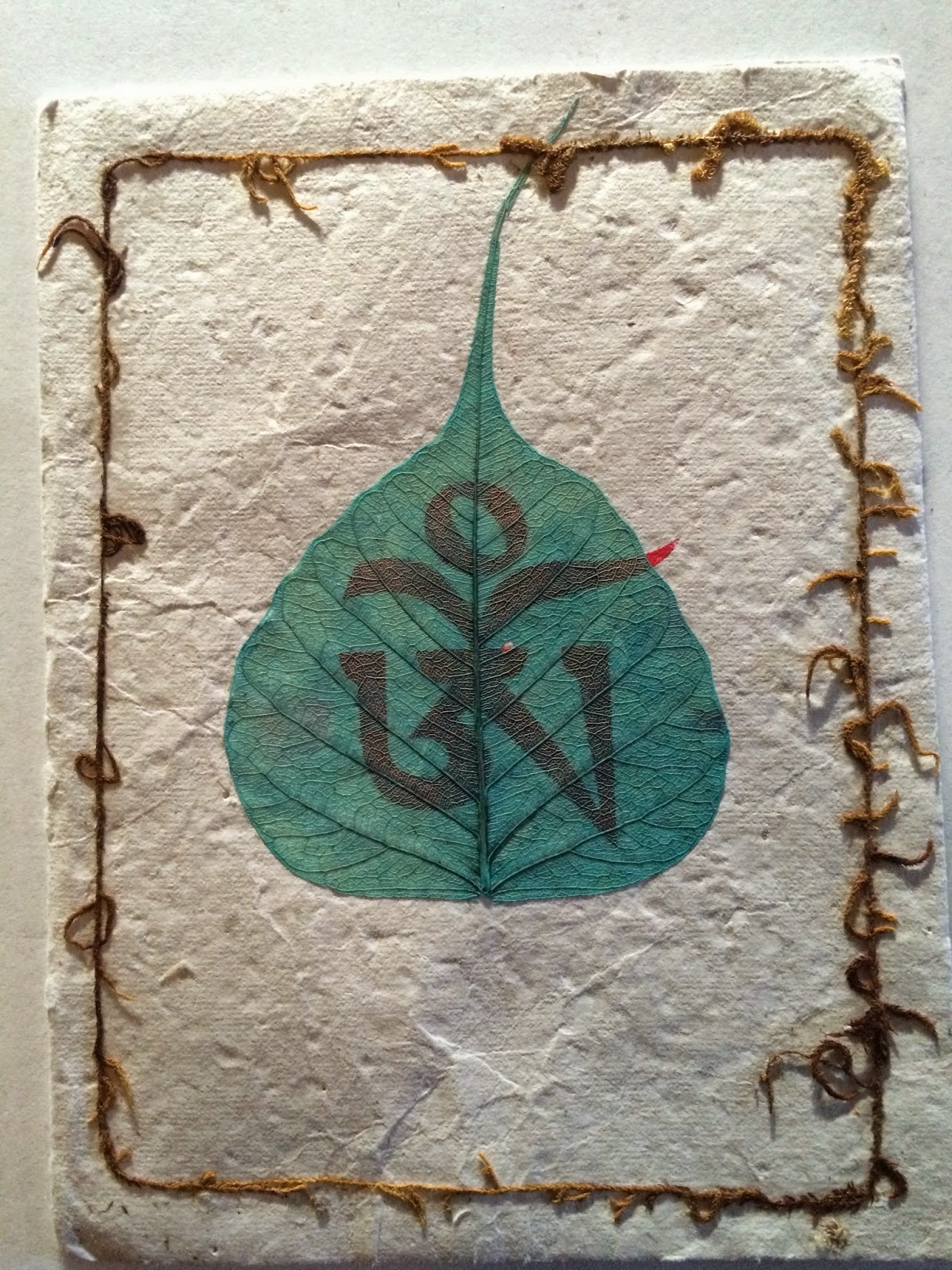
"Om" in Tibetan Script with Bodhi Tree leaf from Bodhgaya

Mantra meditation is the bread and butter of Yoga. Through recitation of what are termed "bija" or seed syllables such as "Om" or "Hrim" (for Goddess followers), we can turn the mind to the deeper sources of Ultimate Being. "Om" recitation is central to Hindu, Buddhist and Jain meditation practice. But does mantra meditation also extend to the West in a version adapted to Western philosophy and religious prayer? Many have argued that the Jesus prayer: "Lord, Jesus Christ, have mercy on me, a sinner" (sounds less daunting and self-denigrating in Greek) is an adoption/independent innovation of Buddhist/Yoga mantra meditation, but I would search for a connection to Greek/Hellenistic/Roman philosophy before tagging the correspondence to Buddhist-Christian interactions. 

What is prototypical about mantra meditation is its use of sound to arouse and shift consciousness into a meditational state of mind. The Neoplatonists, like Plotinus, actually sought for ideas from India to fertilize their philosophical ideas and contemplative practices. The Indian emperor Ashoka in his 250 BCE edicts  used the word eusebeia as a Greek translation for the Buddhist, Jain and Hindu concept of "Dharma". Eusebeia means good reverence or good awesomeness or or good spiritual worship and, in the Buddhist context, includes right moral action.
 
If reverence for the Divine includes the production of sound syllables then we are in good company.  John Coltrane is his Jazz paean to Nature, "A Love Supreme", also repeats the core melody "A Love Supreme" with riffs by solo horns and woodwinds. Iamblichus, the Neoplatonist philosopher, also heard music as a symbol of divine harmony. He asserts, "Music is moving and sensuous, and that the sound of pipes causes or heals disordered passions...sounds and tunes are properly consecrated to each of the gods, and kinship is properly assigned to them in accord with their proper orders and powers, the motions of the universe itself and the harmonious sounds rushing from its motion." (Iamblichus, On the Mysteries, Emma Clarke, John Dillon, and Jackson Hershbell, trans., (Society for Biblical Literature, Atlanta, Ga, 2003, 118-119). So, according to Iamblichus, "Hrim" connects us to the Goddess, "Om" to the ultimate ground of Being, "Brahman" and the Jesus Prayer to Christ.
 
Music and mantra meditation are then quick avenues to cosmic harmony.
 

Tuesday, April 15, 2014

A Night of Crimson: Blood Moon and Mars

Lunar Eclipse 4-15-14
 
It is hard to convey the peaceful energy of a midnight lunar eclipse. The reddening of the moon's globe, Mars is just nearby--at once both spurring and becalming the soul. The ancient Stoics developed a cosmology in which everything in the universe is interconnected and unified through pneuma, "breath of life", if you will. So, Hellenistic astrology sought for correspondences between planetary and lunar attributes and the vicissitudes of the human soul. The moon was a ruler of a maternal embodiment and Mars, a master of impulsive drive. 
 
To me, gazing at the sky and resonating with heavenly characteristics is not an attempt to overcome fate through astrological micro-management, but a means for experiencing the interconnection of all things, my particular brand of pantheism. One prominent Neoplatonist, Plotinus, rejected Hellenistic astrology, believing that the human soul could rise to God or the One without intermediaries. But most Neoplatonists after him rejected the hubris of doing it alone and incorporated some form of ritual or slow cultivation of virtue to attain a relationship to the Divine. 
 
The Transcendentalist, Emerson, and some Unitarians of the 19th century tended to line up with Plotinus asserted the inherent goodness and reflective capabilities of human beings while the Universalists seem more akin to the Stoics believing that humans are nursed and nurtured by a good universe. Well tonight, around midnight, I feel nurtured by the crimson sky.

Monday, April 7, 2014

Are You a Redwood or a Rhododendron?

 I frankly recoil whenever I see one of those online personality tests purporting  to tell me what food I am or what what color--it is as though we could be confined to a single term to describe ourselves fully to others. Well, on a recent walk in Sequoia Park in Eureka, I decided to cave. Transfixed by the afternoon shadow play of light, glinting trees and  splashy rhododendrons, I figured out that people were either redwood or rhododendron types--massive, steady and self-contained or variegated pink and rosy flourishes of inspiration. 
The 18th century philosopher, Edmund Burke, contrasted the aesthetic idea of the sublime to the beautiful. He wrote:

"For sublime objects are vast in their dimensions, beautiful ones comparatively small: beauty should be smooth and polished; the great, rugged and negligent; beauty should shun the right line, yet deviate from it insensibly; the great in many cases loves the right line, and when it deviates it often makes a strong deviation: beauty should not be obscure; the great ought to be dark and gloomy: beauty should be light and delicate; the great ought to be solid, and even massive. They are indeed ideas of a very different nature, one being founded on pain, the other on pleasure; and however they may vary afterwards from the direct nature of their causes, yet these causes keep up an eternal distinction between them, a distinction never to be forgotten by any whose business it is to affect the passions." 

So, if you're sublime, then you are awe-striking, a bit melancholic and domineering in your emotional influence on others while, if beautiful, like our rhododendrons, your emotional style is quainter and quieter, perhaps kind and sanguine in relationship and mood.  Later philosophers and poets opposed the sublime nations of Northern Europe to the beautiful Mediterranean in a way to bolster Romanticism over Classicism in artistic and literary style. Could our Unitarian Universalism, like the bifurcated Yang and Yin of Chinese cosmology, also echo the contrast between the sublime and the beautiful, the unity of God to the varied manifestations of Universal Love?
Maybe, just maybe, I can retract my initial hesitation to categorize. More like emotionally tinged ideas and root guiding metaphors, we are sublime or beautiful, not in character, but in experience--each moment diving us into majesty or love whenever we enter a state of deep contemplation. We are both redwoods and rhododendrons.
                                                                                                                                                                  

Saturday, March 29, 2014

O What Can Ail Thee?


O what can ail thee, knight-at-arms,
Alone and palely loitering?
The sedge has withered from the lake,
And no birds sing.

John Keats, La Belle Dame sans Merci

Spring has returned! Ducks sing and the sedge is green. I have always cherished Keat's poem. It has sustained me through wintry blues and shivering thoughts. But like our cyclic seasons, I always open my heart to nature's annual restoration. The femme fatale of Keat's epigrammatic lyric is a fairy of sorts, one who stole his heart. The frank allure of a personal pantheism, particularly for me who usually personifies Nature as Goddess-like, is its capacity for supporting a rich emotional fabric of ideas and its poignant stories of Goddess as lover. 

John Ruskin, the 18th century critic, coined the term, "pathetic fallacy", to deride the tendency of Romantic poets to ascribe human feelings to nature--the weeping willow cried. But, as I have often proposed, an emotional-intuitive personifying of nature and her herd of beings not only draws us closer to an ultimate unifying experience, but also helps us pastorally to fathom the ups and downs of relationships and fortune without devising an all-powerful and all-good deity. Life just sucks at times and life invites rejoicing at other moments. Spring follows winter and winter follows spring.

By striking down hierarchical notions of God, we enter a more level playing field, where all beings can aspire to tranquility, not by salvation through grace, but by salvation through effort, love and stillness. Perhaps, as the Jains believe, gods and goddesses are beings who through personal effort have achieved an enduring tranquility and so we emulate them. Maybe even Nature, herself, is temperamentally both balanced and active, having found that perfect, optimal and seasonal regulation of mood in a changing and chaotic realm of experience. Maybe, that is Divine Love.

Monday, March 17, 2014

When Nature Gets Personal

Pantheism visits us with many different faces. Awareness of the great cosmic expanse, the mysteries of quantum fields, an appreciation of our utter dependence on this sustaining Earth. What all forms have in common is a very present, immanent relationship to the world and universe in which we are embedded. No transcendental person God, remote from our very core, our sinews and bones and minds, informs the pantheistic life.

Being an emotional and intuitive and relational person, I find that my deepest source of the Divine is like me--emotional and relational. Not some abstract force or energy field--although I am agnostic about whether physics will someday discover consciousness or affective charge as part and parcel of all constituents of our perplexing universe--but a person characterizes my concept of Spirit. A kind of all-pervasive soul with whom I can cry or rejoice or seek solace in or, in those exceedingly rare and special moments, become unified with. To be an authentic personal pantheist, I hold that each being in nature shares personhood, even apparently inanimate objects like the mossy stone, tripartite trunk, and the bursting rivulet caught in the image above.

To the many pantheists among us who decry personal ideas of God, yes, I do understand--but my peculiar sensibility to emotion and the poetic compels me to construct a personal pantheism. Or as the Presocratic philosopher, Xenophanes, states:

“The Ethiops say that their gods are flat-nosed and black,
While the Thracians say that theirs have blue eyes and red hair.
Yet if cattle or horses or lions had hands and could draw,
And could sculpture like men, then the horses would draw their gods
Like horses, and cattle like cattle; and each they would shape
Bodies of gods in the likeness, each kind, of their own.”

Let each of us create the Divine in our own image and realize that we are created in the image of our own Divine.

Friday, March 14, 2014

Is God a Goddess?: Unitarian Roots of the Divine Feminine

Late Cypriot Ceramics from V. Karageorghis, "Ancient Art from Cyprus", The Cesnola Collection at the Metropolitan Museum of Art NYC

As Unitarian Universalists, we view our theologies as a garden of diverse possibilities, from Orthodox Christianity to Neo-Paganism to Atheism. I recently preached on the origins of the Divine Feminine in the Unitarian branch of our denomination. Viewing the Divine as more nurturing than judgmental, I naturally sought for the moment when Unitarian Universalists adopted a maternal image of divine action. 
 
The Unitarian and Transcendentalist minister, Theodore Parker, out of mid 19th century Boston, wrote  a prayer:
"Eternal One, I bathe my soul in Your infinity.
Transcendent God! Yet, ever immanent in all that is, I flee to You, and seek repose and soothing in my Mother’s breast. From all this dusty world, You will not lose a molecule of earth or spark of light. Father and Mother of all things that are, I flee to You, and in Your arms find rest; My God! I thank You for Your love."

Aside from The Shakti devotees of India, this prayer may be one of the earliest expression of God as characteristically feminine and nurturing rather than masculine and authoritarian image that we mostly subscribe to. It is no wonder that Parker lost his mom at age 12 and was in the throes of a radical shift in parenting style in Victorian New England where children learned through varied experience and reflection(Louisa May Alcott, Little Women) rather than through authoritative transmission of culture and ideas. That idea of the Mother Goddess, or the androgynous concept of God's action in the world, may have taken root in Victorian/Transcendentalist child-rearing practices of the era. We, Unitarian Universalists need to remember our history. Instead of flailing about in a web of uncertainty, we should covet the rich, prophetic and foreshadowing qualities of our theological traditions.