Cave of Saint Mary Magdalene Interior Grotto
Cave of Saint Mary Magdalene
The air of Provence is redolent with mystery. Provence, itself, is a hybrid of cultures--the Greeks who founded Marseilles in 600 BCE, the local Celtic-Ligurians who traded with them for wine and the Romans who established a series of cities in interior Provence along the Aurelian Way. In the midst of this cosmopolitan province arose the story of Mary Magdalene's life after Jesus. Mary is reported to have sailed from Palestine or Ephesus and landed near the mouth of the Rhone with her brother, Lazarus, her sister, Martha, her handmaiden, Sarah, and an early disciple, Maxmin. Mary then went on to evangelize the people of Marseille.
After a few years, Mary Magdalene retreated to a remote cave at the top of a mountain, named Sainte Baume. There she became a contemplative and is said to have been elevated by angels seven times each day on account of the depth and intensity of her prayers.
Sainte Baume--photos above--is isolated and exhausting to hike up to. But the exhaustion was sweet and meditative and transforming in its quietness. Our guide told us that the mountain was a center of feminine spirituality, even before Christianity, where the forest leading up to the grotto was a Druid sacred space.
It is astounding how different Provencal spirituality feels from the spiritual disciplines we liberal religious folk usually employ for self-cultivation. At once emotional and profound, it is difficult to acquire a sense of detachment from either the world or the Divine. The adoration of Mary Magdalene more resembles the bhakti (devotional) yoga of South Asia than the detached, raja (royal) yoga of renunciates. In fact, the Gypsies of Provence who originate from India will each year celebrate the arrival of Mary Magdalene and Sarah to the mouth of the Rhone similar to the worship of the goddess Parvati or Lakshmi in India.
A cosmopolitan Provence has implanted diverse and syncretic religious practices on its rich vintage soil.
This blog is devoted to the interfaith wisdom and spiritual practices derived from the ancient religions and philosophies of the Mediterranean. The perspective is that of a Unitarian Universalist psychotherapist, psychiatrist, and intern minister. I use the Mediterranean as a root metaphor of cosmopolitan ethics, spirituality and values.
Thursday, October 24, 2013
Tuesday, October 15, 2013
Science and Religion: Contemporary Encounters through Archaeology and Anthropology
In 1959, the renowned physicist and novelist, C. P. Snow, delivered an address entitled The Two Cultures in which he bemoaned the unfathomable gulf between scientific and humanistic literacy. Each enterprise was just too narrowly focused to bridge the difficult policy decisions of the modern world which, he felt, required an integration of scientific methodology with the insights into the human condition furnished only by an artistic or literary understanding of the expressive life. I am not sure that we have overcome this divide in the half-century since his lecture, but many liberal religions, such as Unitarian Universalism, pay lip service to their reconciliation in sermons and in religious education.
C. P. Snow, however, was not so acquainted with certain social sciences--particularly from North America--that from their inception have attempted such an integration. I'm thinking, most particularly, of anthropology and archaeology which ever since the 1960s have sought a scientific approach to interpreting cultural phenomena.
This week, a couple of fascinating reports from these fields have the capability of transforming our biased views about religion and ethics. The first is a study conducted by the anthropologist Dean Snow (no relation, I presume) from Penn State. He analyzed a large set of Paleolithic cave paintings from Spain and France such as those made famous in Werner Herzog's 2010 surreal documentary Cave of Forgotten Dreams. Received opinion concluded that the uncannily representational drawings of bison and bears and horses were drawn by men--male hunters who represented these animals as a form of sympathetic magic to facilitate their kill. Dean Snow, rather conclusively showed that the adjoining hand prints to these cave paintings were female hands, based on the ratio of digit lengths, index to middle fingers. Since the 1800s, we have often heard that religion and art were invented by men for the purpose of facilitating hunting; Snow's results leave us in a quandary of interpretive mud. What were cave women doing when they painted wild animals. Could we be witnessing the rudiments of eco-theology? A harmonizing of the human with the wild?
Another study conducted by the primatologist Frans de Waal from Emory University found that the odd species of chimps, the bonobos, whose hierarchies are based on affectional rather than aggressive behavior, exhibit empathy toward orphaned bonobos through hugging and other forms of close physical contact. The Ancient Near Eastern religions, Mesopotamian and Israelite, frequently dictate an ethical concern for orphans and widows. Could we have inherited such a specific empathic concern? Could our God, as well as our primate behavioral genetics prime us to console those who are underprivileged or lost--an inchoate liberation theology among bonobos?
Perhaps science and religion are mutually reflecting enterprises, if we delve deeply enough.
C. P. Snow, however, was not so acquainted with certain social sciences--particularly from North America--that from their inception have attempted such an integration. I'm thinking, most particularly, of anthropology and archaeology which ever since the 1960s have sought a scientific approach to interpreting cultural phenomena.
This week, a couple of fascinating reports from these fields have the capability of transforming our biased views about religion and ethics. The first is a study conducted by the anthropologist Dean Snow (no relation, I presume) from Penn State. He analyzed a large set of Paleolithic cave paintings from Spain and France such as those made famous in Werner Herzog's 2010 surreal documentary Cave of Forgotten Dreams. Received opinion concluded that the uncannily representational drawings of bison and bears and horses were drawn by men--male hunters who represented these animals as a form of sympathetic magic to facilitate their kill. Dean Snow, rather conclusively showed that the adjoining hand prints to these cave paintings were female hands, based on the ratio of digit lengths, index to middle fingers. Since the 1800s, we have often heard that religion and art were invented by men for the purpose of facilitating hunting; Snow's results leave us in a quandary of interpretive mud. What were cave women doing when they painted wild animals. Could we be witnessing the rudiments of eco-theology? A harmonizing of the human with the wild?
Another study conducted by the primatologist Frans de Waal from Emory University found that the odd species of chimps, the bonobos, whose hierarchies are based on affectional rather than aggressive behavior, exhibit empathy toward orphaned bonobos through hugging and other forms of close physical contact. The Ancient Near Eastern religions, Mesopotamian and Israelite, frequently dictate an ethical concern for orphans and widows. Could we have inherited such a specific empathic concern? Could our God, as well as our primate behavioral genetics prime us to console those who are underprivileged or lost--an inchoate liberation theology among bonobos?
Perhaps science and religion are mutually reflecting enterprises, if we delve deeply enough.
Monday, October 7, 2013
Nine Days with Divine Mother: Celebrating Navaratra
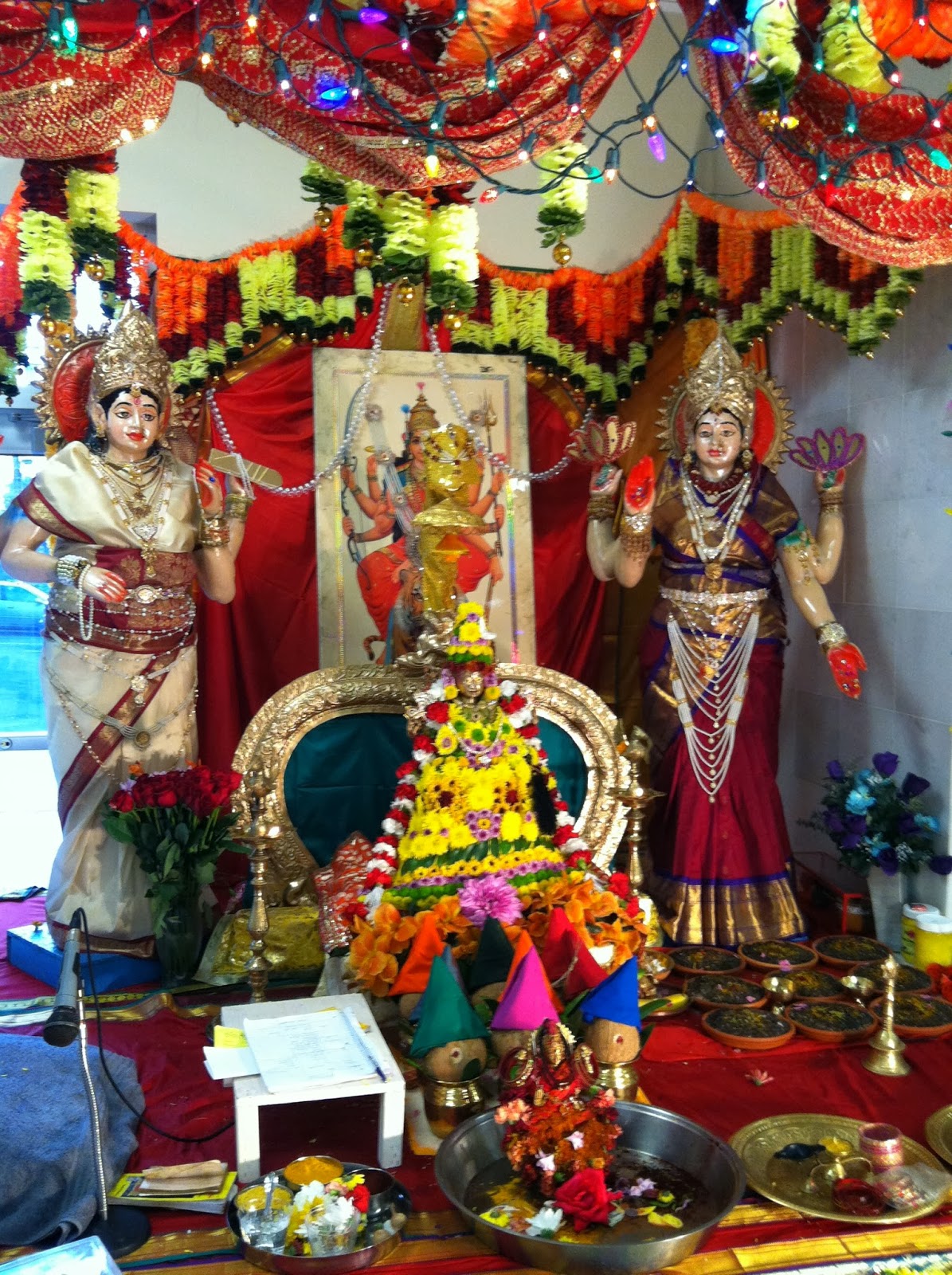
Parvati--Chicago Art Institute Puja for Gauri Devi Sunnyvale Temple
From October 5th through October 13th, we enter a nine-day period of worship and celebration, termed Navaratra, for the Hindu Goddess, Durga, in adoration of her manifold ways of being in the world. Durga is a complex and dynamic figure who, as a warrior goddess, kills demons that the gods could not overcome and who, as a nurturing and devoted protectoress, Gauri-Parvati, sustains beauty and love in the world. To the devotees of Shakti--the primordial and active feminine power that undergirds the universe--Durga, in her many manifestations, is their personally chosen deity. She supports a kind of monotheism of worship and meditation while sustaining the pluralism of the world.
I had the great pleasure of visiting and attending one evening of puja (worshipful offering) for Gauri-Parvati at the Sunnyvale Hindu Temple in Sunnyvale, CA. What a transforming experience! Flooded in variegated colors, circling around scores of diverse god and goddess images, smelling the sweet aromas of incense and fruit and milk, hearing bells resounding as multitudes of devotees capture moments of intentional meditative awareness, I was in awe! How different is the pluralist market of Hindu devotional religion from the Protestant simplicity of form. Yet underneath this surface polytheism and perceptual richness lies a singleness of purpose and devotion that is often lacking among the liberal religious. As a devotee, I choose the corner of the temple where the image of my god or goddess resides. In Hinduism, no dogma dictates to whom I express my praise. A unity in a kaleidoscope of multiplicity--all under the same temple roof.
Monday, September 23, 2013
Does God have Post-Traumatic Stress Disorder?
Last week, I was talking to a friend who is an Evangelical street minister from East Oakland. She, herself, lost a son to a drive-by shooting and she was complaining that it is difficult to get folks to turn to God or Jesus on the streets of Oakland because so many have witnessed friends, children and other family members killed by violence. They ask, "Why doesn't God intervene at these unfathomable horrors and stop them? Where is God?" An unusual thought occurred to me, when I heard about their incredulity from my friend. I spurted out, "Maybe God has PTSD from witnessing the violence on the streets." My friend responded, "That's deep. Maybe God is sad."
As I reflect on our conversation, I'm getting increasingly convinced that God has PTSD, Post-Traumatic Stress Disorder. Like Vets returning from Iraq and Afghanistan, women and men who are victims of sexual assaults, and those witnessing street violence in the inner city or in Baghdad or those touched by the terrorism in Nairobi, maybe God feels survivor guilt and withdraws her/his will from intervening in human events on account of her despondency.
This quirky twist on the "problem of evil" or, more technically, theodicy, assumes that God is a present witness to the world. Theologians, such as Sallie McFague, posit that the universe could be viewed as the "Body of God" and that rich metaphoric descriptions of God, such as God as Mother or Friend or Healer, are paths leading away from the theological literalism of Fundamentalism or the irrelevancy of God as Father to contemporary culture. If the world is God's body and her body is assaulted by violence and pollution and neglect, it would seem natural that she or he would develop PTSD.
The idea that God might have PTSD hearkens back to the city lamentations of the Ancient Near East. In the Mesopotamian Laments of the City of Ur, the goddess Ningal weeps for the ghostly desolation that has befallen her beloved city, Ur. She is tearful and sad, like my friend's God who mourns over the unspeakable devastation and the loss of the children of Oakland. If God were all-powerful, then he could of course, in principle, intervene; if God were empathic, the she would cry over incomprehensible pain and loss. I choose empathy over power; loving awareness over detached principles. A traumatized God is preferable to an indifferent deity, if we are created in the image of the Divine.
As I reflect on our conversation, I'm getting increasingly convinced that God has PTSD, Post-Traumatic Stress Disorder. Like Vets returning from Iraq and Afghanistan, women and men who are victims of sexual assaults, and those witnessing street violence in the inner city or in Baghdad or those touched by the terrorism in Nairobi, maybe God feels survivor guilt and withdraws her/his will from intervening in human events on account of her despondency.
This quirky twist on the "problem of evil" or, more technically, theodicy, assumes that God is a present witness to the world. Theologians, such as Sallie McFague, posit that the universe could be viewed as the "Body of God" and that rich metaphoric descriptions of God, such as God as Mother or Friend or Healer, are paths leading away from the theological literalism of Fundamentalism or the irrelevancy of God as Father to contemporary culture. If the world is God's body and her body is assaulted by violence and pollution and neglect, it would seem natural that she or he would develop PTSD.
The idea that God might have PTSD hearkens back to the city lamentations of the Ancient Near East. In the Mesopotamian Laments of the City of Ur, the goddess Ningal weeps for the ghostly desolation that has befallen her beloved city, Ur. She is tearful and sad, like my friend's God who mourns over the unspeakable devastation and the loss of the children of Oakland. If God were all-powerful, then he could of course, in principle, intervene; if God were empathic, the she would cry over incomprehensible pain and loss. I choose empathy over power; loving awareness over detached principles. A traumatized God is preferable to an indifferent deity, if we are created in the image of the Divine.
Saturday, September 14, 2013
A Unitarian Universalist Confessional Prayer
During these
High Holy Days of Judaism, there is a specific practice, called Tashlikh.
Celebrants will gather by a body of flowing water and cast off their sins into
the sea. The best water will have fish in it, which, as one friend told me, can
symbolize the open eyes of the Holy One, observing our actions. Last Sunday, at
the Starr King Unitarian Universalist Church in Hayward, CA, we recited a
litany prayer, with one line spoken by the worship leader and the response in
italics by the congregation:
We have turned
to pride over humility, arrogance over humbleness.
May we wash away our flaws in the cool
waters of forgiveness.
We have loved
ourselves over others.
May we wash away our flaws in the cool
waters of forgiveness.
We have remained
silent in the face of injustice.
May we wash away our flaws in the cool
waters of forgiveness.
We have hunkered
down in fear rather than breathing out compassion.
May we wash away our flaws in the cool
waters of forgiveness.
We have clung to
the familiar instead of opening up to the new.
May we wash away our flaws in the cool
waters of forgiveness.
We have tread on
the fragile earth rather than preserving the greenness of life.
May we wash away our flaws in the cool
waters of forgiveness.
We have been
quick to anger rather than wise in slow hesitation.
May we wash away our flaws in the cool
waters of forgiveness.
We have been
fractious in our demands rather than unified in spirit.
May we wash away our flaws in the cool
waters of forgiveness.
Let us love and
forgive and mirror the Divine waters
Which erode away
error and smooth over harshness
That we may,
with intention and love, renew our commitment to justice, compassion, unity and
discovery for another year.
Amen and Blessed
Be
Thursday, September 5, 2013
God is Love...Or not?
One of the most common and extensive monikers for the Christian God is "Love". 1 John 4:8 proposes that "Whoever does not love does not know God, for God is love" (NRSV). Indeed for Unitarian Universalists, our Universalist strand of theological inheritance is grounded on the belief that God is love and a loving God could not condemn anyone to Hell. In addition to this equation of God as Love, almost every church that I've attended, including some UU congregations, will argue, in sermon after sermon, that Christian love is agape--akin to familial or selfless love. Agape is distinct from the Greco-Roman construct of love as eros, typified by the obsessive and chaotic love between ardent lovers. The former pope Benedictus XVI wrote in a 2005 encyclical letter, Deus Caritas Est, that earthly Eros can lead to heavenly Agape, just like, initially, puppy love can lead ultimately to the stability of marital relationships.
My experience as a therapist and a pastor-to-be compels me to recoil at such simplification. The nature of love is turbulent and chaotic, cyclical and unsteady. Living through love is more like tacking through a typhoon than quietly sipping a coffee onshore. But that is not necessarily bad, just psychologically realistic.
Plato in his Symposium on Love presents us with a bevy of beautiful stories and allegories about the nature of love as eros. On such myth, as told through the voice of the priestess Diotima, recounts the genealogical origin of the god Eros. Eros' father, the god, Poros (plenty or resourcefulness), got hammered from drinking nectar at one of Zeus' parties. Eros' mother, Penia (lack or poverty), seduced Poros and later gave birth to Eros whose character traits combined both those of his mother and father. Eros often is in need, empty and squalid like his mother, while, at other times, is resourceful, clever and energetic like his father. He is betwixt and between. Unlike either parent he craves the beautiful because he is simultaneously aware of his emptiness and motivated toward seeking perfection.
We humans are sibs to Eros--body and soul--lack and plenty. We are in urgent need for love, yet, at the same time, aware of its storminess. Let us not forget our humanity is our striving for the impossible perfection of an immutable "God as Love".
My experience as a therapist and a pastor-to-be compels me to recoil at such simplification. The nature of love is turbulent and chaotic, cyclical and unsteady. Living through love is more like tacking through a typhoon than quietly sipping a coffee onshore. But that is not necessarily bad, just psychologically realistic.
Plato in his Symposium on Love presents us with a bevy of beautiful stories and allegories about the nature of love as eros. On such myth, as told through the voice of the priestess Diotima, recounts the genealogical origin of the god Eros. Eros' father, the god, Poros (plenty or resourcefulness), got hammered from drinking nectar at one of Zeus' parties. Eros' mother, Penia (lack or poverty), seduced Poros and later gave birth to Eros whose character traits combined both those of his mother and father. Eros often is in need, empty and squalid like his mother, while, at other times, is resourceful, clever and energetic like his father. He is betwixt and between. Unlike either parent he craves the beautiful because he is simultaneously aware of his emptiness and motivated toward seeking perfection.
We humans are sibs to Eros--body and soul--lack and plenty. We are in urgent need for love, yet, at the same time, aware of its storminess. Let us not forget our humanity is our striving for the impossible perfection of an immutable "God as Love".
Sunday, September 1, 2013
Christ the Teacher: Buddha the Preacher
Sarcophagus from the Crypt of the Abbaye of Saint-Victor Marseille France
Christ Teaching Peter and Paul 4th Century CE
Architectural Element from Gandhara, N Pakistan SF Asian Art Museum
Deities Imploring Buddha to Preach 100 to 300 CE
Don't we usually imagine Jesus as a preacher--Sermon on the Mount--and Buddha as a wise and psychologically insightful teacher of the Dharma? In these two images, a reversal of roles of these two community ministers compels us to re-imagine their messages. The early Christian iconography of traditio legis or Christ's handing down the law to Peter and Paul derives from Roman images of philosophers or emperors passing on knowledge or decrees, while Greco-Buddhist iconographic tradition of Buddha being coaxed by the gods to preach the Dharma comes from sutras narrating stories from Buddha's life. What these images share is an uncanny visual artistic style, that of the Hellenistic sculptural tradition. Here Provence meets Pakistan and Christ meets Buddha in a feast of the hybrid. Both Buddha and Christ preach and teach their respective laws through the medium of an expansive iconography that stretches across Eurasia. Could Christ and Buddha share ethical and sapiential values as well?
Subscribe to:
Posts (Atom)